
Robin's Short Version
- Endometriosis affects an estimated 1 in 10 women and girls of reproductive age, yet diagnosis still takes an average of 7–10 years.
- Two non-invasive tests recently backed for early NHS use could help move diagnosis beyond the old “surgery or nothing” model, though neither is FDA-cleared in the US yet.
- There is no single cure, but investigating pelvic pain, supporting digestion and estrogen metabolism, reducing inflammation, limiting endocrine disruptors, and discussing progesterone support can make symptoms far more manageable.
I've treated thousands of women with endometriosis through Parsley. Every one of them had some version of the same story: debilitating pain, dismissed for years, told it was “just bad periods.”
Suddenly, everyone's talking about it. Bryan Johnson has been documenting his girlfriend Kate Tolo's endometriosis diagnosis in real time — his team says they got her answered in 42 days without surgery. Lena Dunham's new memoir, Famesick, spends its best chapters on the disease that led to her hysterectomy at 31, after doctors found 37 lesions on her liver, spine, and abdominal wall.
Here's what's wild: an estimated 1 in 10 women have endometriosis. It still takes 7 to 10 years, on average, to get diagnosed. And the official “gold standard” test has been exploratory surgery.
If your periods have ever taken you out for a day (or more) — that's not normal, and it's exactly the kind of pattern I'd want to map to your labs. Let's figure out what's going on →
This week: what we actually know about endometriosis, the two new non-invasive tests just backed by UK regulators, and the functional medicine protocol I use with patients — because there's real hope here, even though we need a lot more research.
⚡ Forward this protocol
The Estrobolome Reset
If you have any signs of estrogen dominance — heavy periods, bad PMS, endometriosis, fibroids — start here: fix your gut's ability to clear excess estrogen.
- 25–35g fiber/day (beans, chia, berries, leafy greens)
- A probiotic + calcium D-glucarate (500mg, 2x/day) — together they stop your gut from recycling estrogen back into your bloodstream instead of excreting it
What to know: it's common, poorly understood, and possibly immune-related
❌ The old assumption: Endometriosis is “just” period pain, and the only way to diagnose it is surgery.
✅ The new reality: An estimated 1 in 10 women and girls of reproductive age have endometriosis — about 190 million people worldwide.1 And diagnosis no longer requires surgery first — updated European guidelines now say imaging plus symptoms should come first, with laparoscopy reserved for unclear cases.2
❝ It still takes an average of 7 years to get diagnosed. Not because we lack answers — because we've relied on surgery to get them.
How it develops
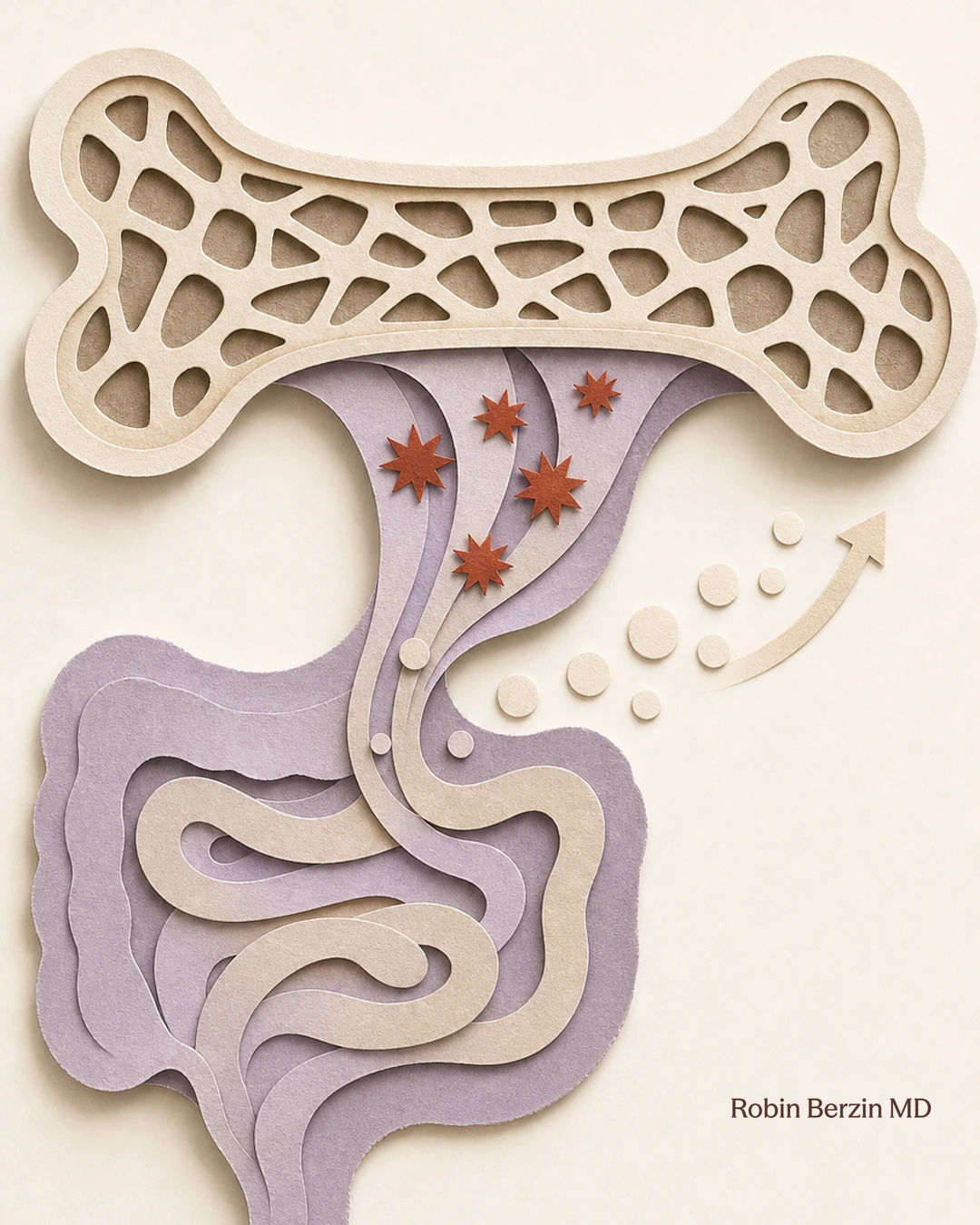
The leading theory: menstrual blood flows backward through the fallopian tubes and implants in the pelvis — “retrograde menstruation,” recently confirmed with DNA evidence.3 But that happens in ~90% of all women. Something else has to go wrong — immune cells failing to clear the stray tissue, inflammatory signaling turning it into something that survives and grows.4
Not officially autoimmune — but your immune system is involved
It's not classified as an autoimmune disease. But a 2025 study found women with endometriosis have roughly 2x the odds of also being diagnosed with an autoimmune condition — RA, Hashimoto's, lupus, MS — within two years.5 Researchers are increasingly calling it a systemic inflammatory disease, not just a “period problem.”
Two new tests might finally end the surgery requirement
In July 2026, UK regulators (NICE) greenlit two non-invasive tests for early NHS use: a saliva test (Ziwig Endotest, 97% sensitive / 94% specific) and a gut-electrical-activity test (EndoSure, 91–96% both).6 Neither is FDA-cleared in the US yet — but it's the first real crack in “surgery or nothing.”
What to do: a real protocol, and hope
1️⃣ Get a doctor who will actually investigate.
Start with an OB-GYN who takes chronic pelvic pain seriously and pushes for imaging instead of “let's wait and see.”
This is exactly what we do at Parsley — we quarterback the workup and build the protocol below alongside your conventional care. Let's get you answers →
2️⃣ Fix digestion first — this is where the estrobolome protocol lives.
Your gut bacteria can “reactivate” estrogen your liver already packaged for excretion, sending it back into circulation.
- 25–35g fiber/day — binds excess estrogen before bacteria can reactivate it
- A probiotic to rebuild Lactobacillus/Bifidobacterium
- Calcium D-glucarate, 500mg twice daily — directly blocks the enzyme (beta-glucuronidase) responsible for reactivating estrogen
- If bloating or constipation are prominent, ask about a SIBO breath test — one 2025 study found overgrowth in 92% of endo patients vs. 83% of controls.7
- The goal: a bowel movement every single day
3️⃣ Target estrogen metabolism with specific supplements.
- Indole-3-carbinol, 200–400mg/day (I use Meta I-3-C). Best human data of the group — shifts estrogen toward its weaker, safer metabolite.8
- Vitamin B6, 50–100mg/day — a direct cofactor for progesterone production
- Vitamin D — get tested. Most women with endo run low; if you're deficient, 2,000–5,000 IU/day with K2 to get into range.9
- Omega-3s, 2g/day — the exact dose used in the only placebo-controlled trial that showed pain reduction.10
- Magnesium glycinate, 200–400mg at night — baseline metabolic support
4️⃣ Try a targeted elimination diet — it's a diagnostic tool, not a fad.
This isn't really about dairy specifically. Cutting inflammatory foods — gluten (highly inflammatory for some people), dairy, and whatever else you're individually reactive to — is genuinely well-evidenced for lowering systemic inflammation, even though the research specific to endometriosis is still slim. I've seen it make a real difference in my patients: one did a strict Whole30 and her symptoms completely resolved.