









My patients have been asking me about plasmapheresis for years.
I’ve watched colleagues offer it at longevity clinics — including at Extension Health in New York, where Parsley has a partnership. I’ve been curious. I’ve also been skeptical.
Robin’s Short Version
- One 2025 study confirmed this directly: after removing certain toxins from plasma, they rapidly flooded back from fat stores — with a rebound ratio of nearly 2x for some compounds.
- A 2025 Buck Institute RCT showed TPE reduced biological age by up to 2.61 years — but only when plasma was replaced with albumin.
- The biggest benefits in the Buck trial went to people with the highest baseline inflammation. If your sleep, nutrition, exercise, and hormones are already dialed in, the marginal return may be pretty low.
For a long time, I didn’t know what to tell people. Not because I hadn’t looked. Because the data wasn’t there. No solid before-and-after testing. No proof it moved the needle on symptoms or longevity markers. Just a very expensive, time-consuming procedure and a lot of hope.
Then Gwyneth Paltrow shared her experience publicly, my inbox filled up again — and two major studies dropped in 2025 that finally gave me something real to work with.
The picture got more interesting. And more complicated.
🤓 What to know: Blood isn’t where most toxins live.
❌ The assumption: Plasmapheresis "cleans" your blood of heavy metals and environmental toxins — and that’s why people are doing it.
✅ The problem with that assumption: Most toxins we worry most about — mercury, lead, pollutants — are stored in fat tissue, bone, and brain. Not circulating plasma. Blood is a transit system, not a storage depot.
One 2025 study[1] confirmed this directly: after removing certain toxins from plasma, they rapidly flooded back from fat stores — with a rebound ratio of nearly 2x for some compounds. You can filter the river, but if the source is upstream, it fills right back up.
✅ What TPE actually does: As we age, plasma accumulates something called "SASP factors" — these pro-inflammatory proteins from dying cells that actively suppress tissue repair. Replacing that plasma with albumin (an antioxidant and immunomodulator) resets the environment. Research from the Conboy lab at UC Berkeley showed TPE restored youthful balance across the key inflammatory signaling pathways.[2]
A 2025 Buck Institute RCT[3] showed TPE reduced biological age by up to 2.61 years — but only when plasma was replaced with albumin. A separate 2025 study[4] found that removing plasma without albumin replacement may actually accelerate epigenetic aging. What goes back in matters as much as what comes out.
⚠️ The caveats:
- The Buck trial had only 44 participants and was funded by Circulate Health, a company with commercial interest in TPE.
- No long-term clinical outcomes data yet. We don’t know if biological age reduction on epigenetic clocks translates to fewer diseases or longer life.
- At $10,000–$15,000 per session, that’s a meaningful gap.
The biggest benefits in the Buck trial went to people with the highest baseline inflammation. If your sleep, nutrition, exercise, and hormones are already dialed in, the marginal return may be pretty low. TPE is not a shortcut.
💪 What to do: Ask these questions before spending anything.
Step 1: Know what you’re actually trying to detox.
If your concern is heavy metals or toxin burden, ask your doctor to run a heavy metals panel first. TPE is probably not the most direct intervention — chelation therapy (oral or IV) and reducing ongoing exposure address that problem at the source.
Step 2: Demand albumin replacement.
Not all plasmapheresis protocols are the same. The studies showing biological age reduction all used albumin replacement. The study showing potential harm used none. This is the single most important question to ask any clinic.
⭐ If you do one thing: Demand albumin replacement — the studies showing biological age reduction all used it, and the study showing potential harm used none.
Step 3: Measure before and after.
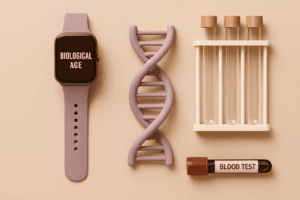
If you’re going to spend this kind of money, measure it. Get epigenetic age testing (TruAge or Tally Health) before your first session and again 6–8 weeks after. Data, not vibes.
Step 4: Fix foundations first.
The biggest benefits in the Buck trial went to people with the highest baseline inflammation. If your sleep, nutrition, exercise, and hormones are already dialed in, the marginal return may be pretty low. TPE is not a shortcut.
The goal: If you pursue TPE, go in with clear expectations — not detox fantasies. The real promise is inflammation reset. That’s worth studying. It may even be worth doing. But only with the right protocol and measurable outcomes.
💛 The Momgevity Files
This week I’ve been reflecting on a concept called: the Myth of the Linear Path.
A close friend of mine is a Yale professor who teaches workshops on how to be good at life — navigating transitions, fighting well with people you love, the art of listening. (Check out Life Shop if you’re curious — I highly recommend it.) I’ve been creating more educational content lately (I taught a live workshop on fertility optimization last week, my first in a while), so I sat in on her life transitions class to see what I could learn.
The message that landed hardest was something I tell friends, patients, and loved ones all the time — but TBH keep forgetting myself: progress is not linear.
It’s showing up everywhere for me right now. I got into weight training, but I keep giving myself sacroiliitis — low back pain at the sacroiliac joint — by moving too fast, so I’m having to slow down and focus on alignment. I started using topical estrogen on my face to prevent skin aging and promptly got acne again, a sign my body isn’t quite ready for even a light dose, at 44. I thought we were settled in our home for a while; it now looks like we may have to move this summer, through forces outside our control. Some of the new directions we’re taking at Parsley are working better than expected. Others need a rethink.
We tend to assume that by midlife, everything should be up and to the right. But there’s no such thing as a linear path. What midlife actually offers — if we let it — is enough self-knowledge to weather the backtracks, side quests, and unwelcome plateaus with more grace.
Longevity requires resilience. Resilience requires perspective. The perspective I’m leaning into: linearity is a myth, but the journey usually brings me somewhere good — even when the path is surprising. Which is giving me the motivation to train slower, hold off on the estrogen, and trust the process.
Have you been tempted by a high-ticket longevity treatment — and either did it or talked yourself out of it? Hit reply.
⚡ One more thing…
Bone health is on my mind right now — personally and clinically. I just published a reel busting the biggest myths about calcium and bone protection. Go watch it here.
One thing I’ve added to my own protocol: AlgaeCal Plus — a plant-based calcium that’s clinically shown to support increases in bone density.
If your DEXA scan showed early bone loss — or you’re in perimenopause and haven’t checked yet — come talk to us. We’d run estradiol, DHEA-S, and a bone resorption marker panel (NTX or CTX) to understand what’s actually driving your loss, then build a protocol around the interventions that move bone density: hormones, resistance training, and targeted supplementation, not just calcium. Talk to a Parsley provider →
Stay strong, stay curious, and breathe,
Robin
Join Parsley using RBMDCREW to save $100 on your membership.
Frequently Asked Questions
Does plasmapheresis actually remove toxins like heavy metals?
The assumption that plasmapheresis "cleans" your blood of heavy metals is the core problem — most toxins we worry about are stored in fat tissue, bone, and brain, not circulating plasma. A 2025 study confirmed that after removing certain toxins from plasma, they rapidly flooded back from fat stores with a rebound ratio of nearly 2x for some compounds. Blood is a transit system, not a storage depot.
How much can plasmapheresis reduce biological age?
A 2025 Buck Institute RCT showed therapeutic plasma exchange reduced biological age by up to 2.61 years — but only when plasma was replaced with albumin. The trial had only 44 participants and was funded by Circulate Health, a company with commercial interest in TPE, so I’m holding the finding with appropriate skepticism while watching for replication.
What is the difference between plasmapheresis with and without albumin replacement?
This is the single most important question to ask any clinic. The studies showing biological age reduction all used albumin replacement — albumin is an antioxidant and immunomodulator that resets the inflammatory environment. A separate 2025 study found that removing plasma without albumin replacement may actually accelerate epigenetic aging. Not all plasmapheresis protocols are the same.
Who is plasmapheresis actually worth it for?
The biggest benefits in the Buck trial went to people with the highest baseline inflammation. If your sleep, nutrition, exercise, and hormones are already dialed in, the marginal return may be pretty low — TPE is not a shortcut. At $10,000–$15,000 per session and no long-term clinical outcomes data yet, I’d fix foundations first and measure before and after with epigenetic age testing if you do proceed.
Scientific References
- Journal of Clinical Apheresis, 2025 — Toxin rebound from fat stores after plasma removal
- GeroScience, 2022 — TPE restored youthful inflammatory signaling balance
- Aging Cell, 2025 — Buck Institute RCT: TPE reduced biological age by 2.61 years
- Scientific Reports, 2025 — Plasma removal without albumin may accelerate epigenetic aging